
Short answer: PadSplit's published fee is the first 10 days of every new member's stay, then 8 percent of what that member pays after that. Because of the 10-day booking fee, the real cost depends on how long people stay: about 10.5 percent on a one-year stay and about 19 percent on a twelve-week stay. PadSplit fills rooms and collects rent. The owner still pays the utilities, repairs, furnishing, and any property manager.
The fee, in PadSplit’s own words
PadSplit’s help center calls it a “10 days + 8%” model. Every time a new member moves in, PadSplit keeps all of that member’s first 10 days of payments as a booking fee. After that it keeps 8 percent of what the member pays. That page was last updated July 17, 2026, so check it for changes before you rely on it.
Two details from the same page:
- If a member leaves before day 10, PadSplit keeps the days they stayed and does not bill you for the rest.
- If a member moves from one of your houses to another, there is no second booking fee.
The fee is 8 percent only if nobody moves out
The booking fee is charged once per move-in, so the shorter the stay, the bigger its share. This is arithmetic on PadSplit’s published model, using a room at $175 a week:
| Member stays | Member pays | PadSplit keeps | Real fee |
|---|---|---|---|
| 4 weeks | $700 | $286 | 40.9% |
| 12 weeks | $2,100 | $398 | 19.0% |
| 26 weeks | $4,550 | $594 | 13.1% |
| 52 weeks | $9,100 | $958 | 10.5% |
So the question that decides your real cost is not “what is the fee.” It is “how long do members stay in my rooms.”
PadSplit’s own example on its host page points the same way. It shows a house collecting $4,183 a month with a PadSplit fee of $502. That is 12 percent, not 8. The same example lists a separate $115 transaction fee. I could not find that line explained in the help center, so ask PadSplit what it covers before you sign up.
A real month from one of my houses
This is the September 2026 earnings statement for one of my Atlanta houses on PadSplit.
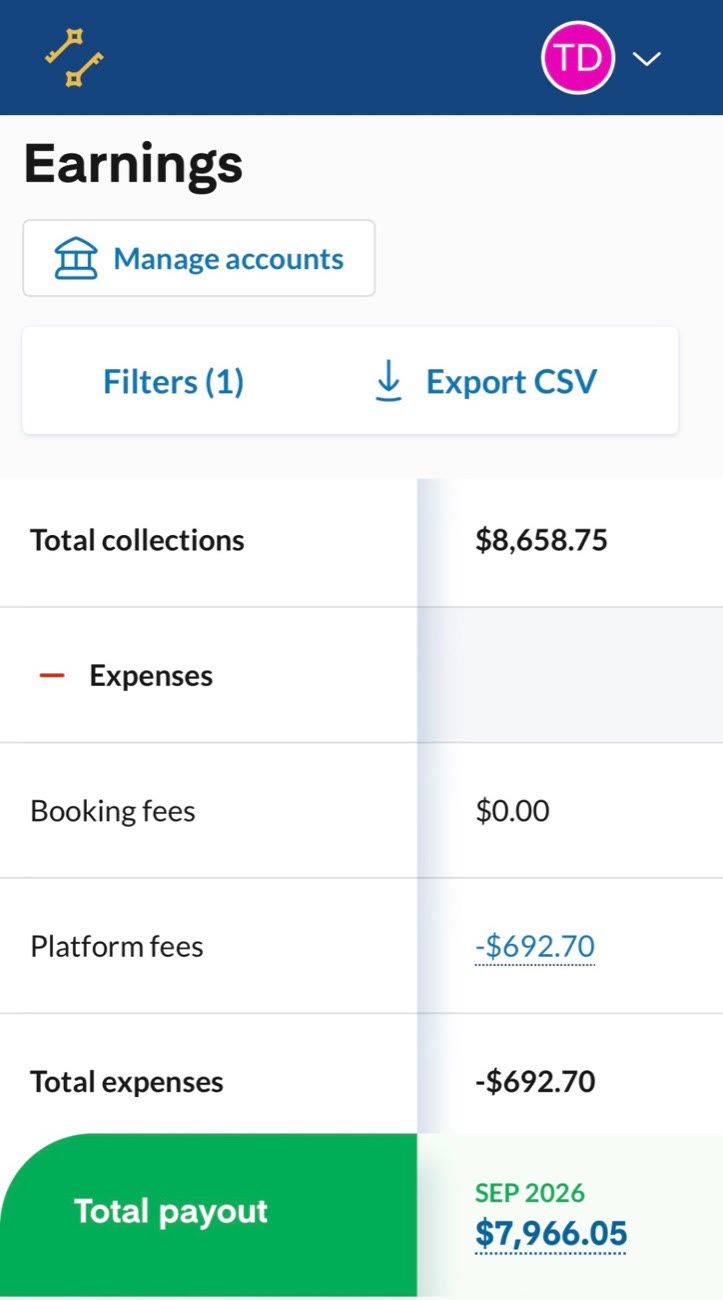
| September 2026 | |
|---|---|
| Collected from members | $8,658.75 |
| Booking fees | $0.00 |
| Platform fees | $692.70 |
| Paid out to me | $7,966.05 |
The platform fee is exactly 8 percent of what was collected. Booking fees were zero, so no new member’s first 10 days fell in that month. This is the fee at its lowest: a full house and nobody moving.
The $7,966.05 is not profit. It is what PadSplit sent me before the mortgage, the utilities, repairs, and every other cost of the house.
When you get paid
Once a month, after the month ends. PadSplit says it aims to finish payouts by the 10th and no later than the 20th.
Plan for the gap. Your mortgage, utilities, and repairs for a month come due before the rent for that month reaches you. Keep a reserve that covers it.
What PadSplit does
According to its host page, PadSplit:
- Advertises your rooms and brings in the applicants
- Runs identity, income, and eviction checks on every member
- Collects the payments
- Gives members a maintenance ticket system that sends the tickets to you
What still lands on you
PadSplit’s own example lists these as the host’s costs: utilities, repairs and maintenance, taxes, insurance, room turns, and a property manager fee. You also furnish the rooms and keep the house in shape.
PadSplit fills the rooms and moves the money. It does not run the house. Either you do that, or you pay a manager who does.
PadSplit or self-manage: how to decide
Turn the fee into dollars first. Take five rooms at $175 a week. Full, that is about $3,790 a month. If your members stay around six months, the real fee is about 13 percent, or roughly $495 a month.
That $495 is the price of three jobs: finding applicants, screening them, and collecting the rent. Self-managing means you do those three jobs yourself, or pay someone else to.
So ask one question. Can you fill the rooms and collect the rent yourself for less than $495 a month, counting your own hours and any extra weeks a room sits empty while you look for someone? One room empty for two extra weeks costs $350, which is most of the saving.
Self-managing tends to make sense when you already have a steady source of good renters and a system for collecting. The platform tends to make sense when you do not, or when your time is worth more somewhere else.
Either way, the house still has to be run. The fee does not cover that.
If you decide to try PadSplit
I am a PadSplit host, and PadSplit pays me a referral fee if you sign up as a host through my link and list a house. That is the only connection I have to them, and nothing in this guide changes whether you use the link or not.
Sign up as a PadSplit host with my referral link, or go to padsplit.com directly.
Run the fee through your own numbers
Work out your real fee with the PadSplit fee calculator. Then put the house into the rent-by-the-room calculator. Platform fees belong in the operating expenses line. Use your real fee, not 8 percent, and see whether the house still clears the bar in rent by the room vs. whole house: the math.
New to the model? Start with what coliving investing is.
Common questions
What percentage does PadSplit take from hosts?
PadSplit's help center describes a '10 days + 8%' model: it keeps 100 percent of the first 10 days of each new member's stay as a booking fee, then 8 percent of all payments after that. The effective rate is higher than 8 percent whenever members turn over.
When does PadSplit pay hosts?
Monthly, after the month ends. PadSplit's help center says it aims to complete payouts by the 10th of the following month and no later than the 20th.
Who pays the utilities on a PadSplit house?
The owner. PadSplit's own income example for hosts lists utilities, repairs, taxes, insurance, room turns, and a property manager fee as host costs.
Is PadSplit worth it compared with self-managing?
Work out your real fee in dollars from how long your members stay, then ask whether you could fill the rooms and collect the rent yourself for less than that, counting your own time and any extra empty weeks. If you can, self-manage. If you cannot, the fee is buying you something.
Education only, not financial, legal, or tax advice. Worked examples use round numbers to show the method and are not real properties unless they say so.